A nonhormonal menopause treatment needs to answer a specific question: fewer hot flashes, less severe episodes, fewer symptom-related awakenings, or something else? SKYLIGHT 1 tested fezolinetant primarily against the frequency and severity of moderate to severe vasomotor symptoms—the medical term for hot flashes and night sweats. It found improvements compared with placebo, but it did not compare fezolinetant with paroxetine or establish superiority for sleep.
The other essential distinction is between evidence at publication and safety knowledge today. SKYLIGHT 1 reported few liver-enzyme elevations during its initial controlled period. Current US prescribing information for VEOZAH, the oral fezolinetant product, carries a boxed hepatotoxicity warning and requires scheduled liver testing. This analysis uses the indexed SKYLIGHT 1 primary-report abstract and official prescribing information, alongside the paroxetine primary abstract and available full sleep article—not an examination of every trial protocol or supplement.
Study facts at a glance
Randomized population: SKYLIGHT 1 randomized 527 women aged 40–65 with an average of at least seven moderate to severe hot flashes daily. Source 1
Controlled follow-up: The placebo-controlled period lasted 12 weeks, followed by a 40-week active-treatment extension—not 52 weeks of placebo comparison. Source 1 Source 2
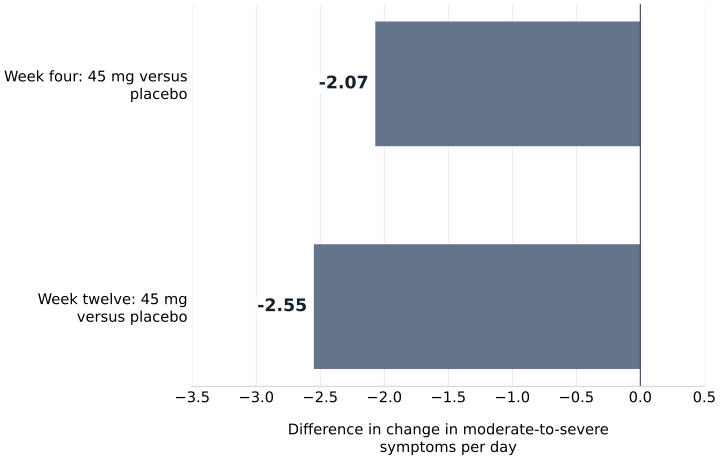
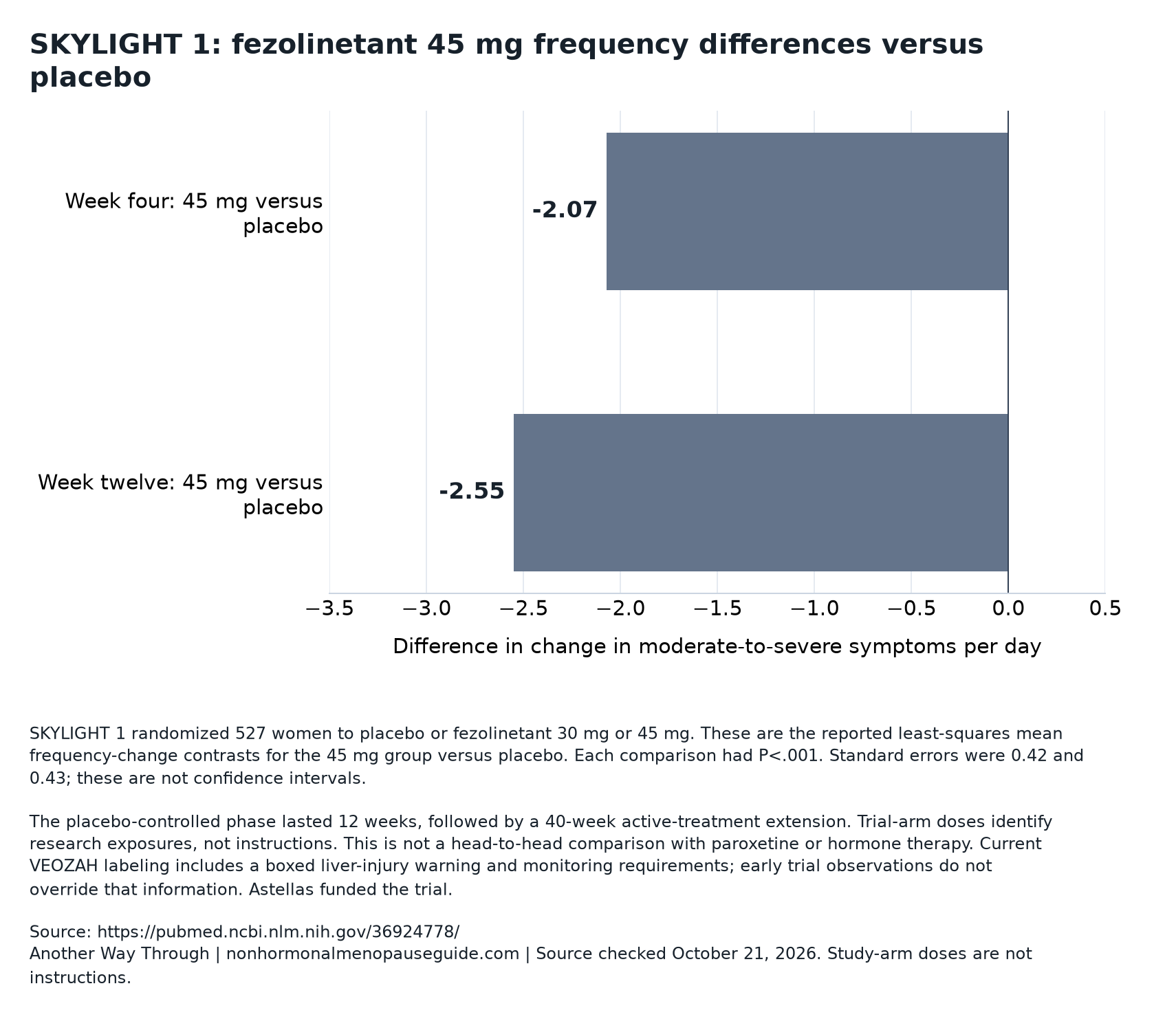
45 mg frequency result: The adjusted difference from placebo was −2.07 episodes daily at week 4 and −2.55 at week 12. Source 1
Current liver-safety requirements: VEOZAH has a boxed liver-injury warning, with baseline testing and follow-up tests monthly for three months, then at months 6 and 9. Source 2
Different research questions: Paroxetine’s predefined sleep analyses measured self-reported symptom-related awakenings and sleep duration in separate trials; they were not a head-to-head comparison with fezolinetant. Source 4 Source 1
Who entered SKYLIGHT 1—and what randomization accomplished
SKYLIGHT 1 was a phase 3 randomized, double-blind study at 97 facilities across seven countries, including the United States and Canada. Participants were women aged 40–65 experiencing an average of seven or more moderate to severe hot flashes per day. Of 2,205 women recruited for evaluation, 527 were randomized; the larger number should not be mistaken for the treatment population.
Assignment was approximately equal: 175 to placebo, 176 to fezolinetant 30 mg, and 176 to fezolinetant 45 mg. Participants received oral treatment once daily. The 30 mg dose identifies a research arm, not a US-approved dosing option. Current VEOZAH labeling identifies a 45 mg oral tablet for moderate to severe vasomotor symptoms due to menopause.
A web-based system assigned treatment, and participants, investigators, clinical staff, and project personnel were masked to assignment. These features make the placebo comparison more informative than a before-and-after symptom report: both groups experienced study participation, while randomized assignment helped separate treatment effects from baseline differences. The trial was funded by Astellas Pharma.
Read the underlying chart data: download CSV or download the source-labeled chart.
Four primary comparisons, not one broad wellness outcome
The coprimary endpoints were changes from baseline in symptom frequency and severity at weeks 4 and 12. Frequency asks how often episodes occurred; severity asks how intense they were. Measuring both prevents a favorable episode count from being treated automatically as evidence that each remaining episode became substantially easier.
Fezolinetant blocks the neurokinin 3 receptor. The label describes its action on neurons involved in temperature regulation, rather than replacement of menopausal hormones. That pharmacology helps explain the treatment’s research rationale, but the clinical evidence still rests on measured symptoms. A plausible biological target does not establish improvements in mood, sexual wellbeing, or every dimension of sleep.
This distinction also helps organize the wider treatment landscape. The guide to nonhormonal hot-flash medicine families separates drug categories from treatment goals. SKYLIGHT 1 supports a defined vasomotor-symptom claim; its abstract specifically identifies further characterization of quality-of-life benefits, including mood and sexual wellbeing, as work still worth doing.
What two fewer daily episodes actually means
For the 45 mg arm, the adjusted difference in frequency change versus placebo was −2.07 daily episodes at week 4 and −2.55 at week 12. Negative values favor fezolinetant because they represent larger reductions. These are additional reductions relative to placebo—not the total number of episodes removed from each participant’s baseline.
The label makes that distinction tangible. In its rounded SKYLIGHT 1 results, baseline frequency averaged 10.4 episodes daily with 45 mg and 10.5 with placebo. At week 4, adjusted changes were −5.4 and −3.3, respectively. Subtracting the placebo change leaves about 2.1 additional episodes reduced daily. At week 12, displayed changes were −6.4 and −3.9. Their rounded values subtract to −2.5, while the label gives the separately rounded treatment contrast as −2.6. The primary report’s more precise contrast is −2.55; calculations from rounded arm values need not reproduce it exactly.
These averages do not mean everyone experienced the same improvement or became symptom-free. They describe a group-level treatment effect after accounting for improvement in the comparator group. The sizable placebo response is part of the result, not a reason to discard it: without the comparator, the total decrease would overstate the effect attributable to treatment.
SKYLIGHT 1 frequency results: additional change versus placebo in moderate to severe episodes per day
| Study arm | Week 4 contrast | Week 12 contrast |
|---|---|---|
| Fezolinetant 30 mg research arm | −1.87; standard error 0.42 | −2.39; standard error 0.44 |
| Fezolinetant 45 mg arm | −2.07; standard error 0.42 | −2.55; standard error 0.43 |
| 45 mg, rounded official-label estimates | −2.1; 95% CI −2.9 to −1.3 | −2.6; 95% CI −3.4 to −1.7 |
Uncertainty and severity need their own units
The primary abstract reports standard errors, not confidence intervals, for its frequency estimates. A standard error describes the precision of an estimated group effect; it is not the spread of individual treatment responses. The current label separately supplies rounded 95% confidence intervals. For 45 mg, those intervals exclude zero at both primary time points, supporting a treatment difference rather than no average difference.
Severity also improved compared with placebo. For 45 mg, adjusted differences were −0.19 at week 4 and −0.20 at week 12, with standard errors of 0.06 and 0.08. For 30 mg, the corresponding differences were −0.15 and −0.24. These are severity-score units, not daily episode counts or percentage reductions.
The numerical pattern does not justify declaring one research dose superior to the other. The abstract establishes each dose’s comparisons with placebo, not a demonstrated dose-ranking result. Similarly, statistical evidence for reduced severity does not specify how many participants found the change personally worthwhile. Average symptom scores and individual judgments of relief answer related but different questions.
The extension supports persistence, with a different comparator
The report describes improvements appearing after one week and being maintained over 52 weeks. However, placebo control ended at week 12. The next 40 weeks were an active-treatment extension; the label explains that previous placebo recipients were reassigned to active treatment, while those already receiving active treatment continued.
That design can help assess whether improvement persists during continued exposure. It cannot supply the same year-long estimate of benefit versus continued placebo. The maintained-effect observation and the randomized 12-week treatment contrast therefore deserve separate descriptions rather than a single claim of year-long placebo-controlled efficacy.
Treatment discontinuation also matters. Before week 12, 23 placebo recipients, 31 participants assigned 30 mg, and 13 assigned 45 mg discontinued treatment, mostly because of adverse events or participant withdrawal. These are not all adverse-event discontinuations. The abstract does not provide enough detail to independently reconstruct missing-data handling or determine how every departure affected the estimated treatment effects.
Early adverse-event counts are not today’s liver-risk estimate
During the first 12 weeks, treatment-emergent adverse events occurred in 37% of the 30 mg safety group, 43% of the 45 mg group, and 45% of placebo recipients. Treatment-emergent means an event occurred after treatment began; it does not prove that treatment caused it. Those broad totals also do not demonstrate equal safety for particular serious outcomes.
The safety denominators were 174, 173, and 175, respectively. They differ from randomized counts because not every randomized participant received treatment. The abstract also explains a dosing error that produced different active-arm efficacy denominators: 173 for 30 mg and 174 for 45 mg. Tracking these populations avoids attaching a percentage to the wrong group.
The short controlled period recorded liver-enzyme elevations in two 30 mg recipients, no 45 mg recipients, and one placebo recipient. They were generally asymptomatic and transient. Zero events in that 45 mg group is a historical observation from a limited sample—not evidence that liver injury cannot occur. The current label draws on larger trials and postmarketing experience, which reveal a different safety picture.
The current boxed warning changes the practical interpretation
The February 2026 VEOZAH label carries a boxed warning for hepatotoxicity, meaning liver toxicity. Across three trials, liver transaminases above three times the laboratory upper limit of normal occurred in 2.3% of women receiving VEOZAH and 0.9% receiving placebo. These pooled laboratory findings are not the incidence of serious postmarketing liver injury, whose frequency cannot be reliably calculated from voluntary reports.
Postmarketing cases included serious drug-induced liver injury within 40 days of starting treatment, with symptoms and elevations in liver enzymes and bilirubin. The label requires baseline ALT, AST, alkaline phosphatase, and total and direct bilirubin measurements, followed by testing monthly for the first three months and at months 6 and 9. It prohibits initiation when ALT or AST, or total bilirubin, reaches at least twice the upper limit of normal.
Known cirrhosis, severe renal impairment or end-stage renal disease, and concomitant CYP1A2 inhibitors are contraindications. The interaction restriction includes weak, moderate, and strong inhibitors. The label instructs immediate discontinuation and medical attention for possible liver-injury symptoms, including new fatigue, appetite loss, nausea, itching, jaundice, pale stools, dark urine, or abdominal pain. The liver-monitoring context guide explains the follow-up responsibility without substituting for prescribing information.
Paroxetine’s sleep findings answer a narrower nighttime question
The separate paroxetine program randomized 1,184 postmenopausal women to oral paroxetine 7.5 mg or placebo across two trials lasting 12 and 24 weeks. Its sleep publication analyzed predefined secondary, self-reported outcomes from those same trials—not an independent replication. Weeks 1–12 were pooled; week 24 came only from the longer trial. Noven Pharmaceuticals funded both trials and medical writing support.
At week 4, vasomotor-symptom-attributed awakenings fell 39% with paroxetine and 28% with placebo. From the reported group means, the reductions were 1.39 versus 1.01 awakenings nightly: an additional reduction of 0.38, not 1.39 attributable to treatment. Sleep duration increased 31 versus 16 minutes, a 15-minute between-group difference in change.
There was no significant treatment difference in time to fall asleep. Sleep-interference scores favored paroxetine significantly only at week 4, and general difficulty-sleeping differences were not significant. These results support selected nighttime outcomes, not universal insomnia treatment. The companion paroxetine symptom-and-sleep analysis examines why symptom attribution and diary-based measurement matter.
Different placebo-controlled programs, not a comparative ranking
| Evidence program | Main question discussed here | Boundary of interpretation |
|---|---|---|
| SKYLIGHT 1 fezolinetant | Frequency and severity at weeks 4 and 12 | No direct comparison with paroxetine; extension lacked placebo control |
| Two pivotal paroxetine trials | Vasomotor frequency and severity | One trial missed its week-12 severity endpoint |
| Paroxetine sleep analysis | Symptom-attributed awakenings and sleep duration | Secondary self-reported measures from the same pivotal trials |
Different safety profiles prevent a simple nonhormonal ranking
Paroxetine’s sleep findings do not establish that it is safer than fezolinetant. During treatment, sleep-related adverse events occurred in 3.1% of both paroxetine and placebo groups; that measure excludes many other possible harms. The BRISDELLE label’s pooled phase 2 and phase 3 safety population is also different from the pivotal sleep-analysis population.
Current BRISDELLE labeling carries a boxed warning about suicidal thoughts and behaviors and notes limited information in women using it for menopausal symptoms. Its pooled trials reported three serious suicidal-ideation reactions and one suicide attempt with active treatment, versus none with placebo. Common reported reactions included headache, fatigue-related symptoms, and nausea or vomiting. Other warnings include serotonin syndrome, bleeding, low sodium, and sexual dysfunction.
BRISDELLE is contraindicated with MAO inhibitors within the specified 14-day interval, thioridazine, pimozide, known hypersensitivity, and pregnancy. Its strong CYP2D6 inhibition raises a separate concern about tamoxifen effectiveness; the label describes mixed clinical outcome evidence rather than a universal demonstrated harm. Different populations, follow-up periods, definitions, and denominators prevent valid cross-drug safety rankings from these reports.
Turning evidence into care questions without turning it into a sales claim
Interpretation: the useful decision framework is to match a defined symptom goal with the evidence and safety obligations of a named product. A reduction in daytime episode frequency and an improvement in symptom-attributed nighttime awakenings are not interchangeable outcomes. The visit-goals guide offers a way to organize that distinction before comparing service descriptions.
Interpretation: monitoring requirements also create documentary questions about who orders tests, reviews results, communicates urgent findings, and arranges follow-up. They do not establish a particular price, insurance benefit, or membership value. Readers examining service terms can use the Midi review and Evernow review to check documented arrangements, without assuming either service supplies the studied product or reproduces trial outcomes.
The unresolved research questions remain clinical: how individuals judge the average symptom benefit, how effects persist beyond controlled follow-up, and how longer exposure changes benefit–harm assessment. Results for the studied oral products do not automatically transfer to compounded preparations, altered formulations, or providers. Neither program directly establishes which medicine best fits someone whose dominant problem is unrelated insomnia, mood symptoms, or another menopausal concern.
Questions about the evidence
Does the −2.55 result mean only 2.55 hot flashes improved?
No. It is the additional average daily reduction with 45 mg compared with placebo at week 12. Both groups improved from baseline. The trial’s adjusted contrast separates the treatment-associated difference from the improvement also observed with placebo; it does not describe an individual participant’s total reduction or guarantee symptom elimination.
Did SKYLIGHT 1 demonstrate a full year of benefit against placebo?
No. Placebo control lasted 12 weeks, followed by 40 weeks of active treatment. Continued improvement during the extension supports persistence during treatment, but it is not a year-long placebo-adjusted effect. A separate 52-week placebo-controlled safety trial described in the label should not be confused with SKYLIGHT 1’s extension.
Why require liver tests if no 45 mg liver-enzyme cases appeared in the short trial?
A small group observed for a limited period can miss uncommon harms. Larger pooled trials documented transaminase elevations, and postmarketing reports identified serious liver injury. Current monitoring requirements reflect that broader evidence. The early zero count cannot estimate today’s serious-injury incidence or override the boxed warning.
Do paroxetine’s sleep results show it is better for sleep than fezolinetant?
No. The drugs were not compared directly. Paroxetine’s secondary analysis measured self-reported awakenings attributed to vasomotor symptoms and sleep duration, without a significant advantage in time to fall asleep. SKYLIGHT 1’s primary questions concerned symptom frequency and severity. Comparing unlike endpoints across separate trials cannot establish superiority.
Is a nonhormonal treatment automatically suitable when hormone therapy is unsuitable?
No. Nonhormonal describes what a treatment is not, rather than universal eligibility. VEOZAH has liver, kidney, and interaction contraindications; BRISDELLE has different contraindications and warnings. Both are labeled for moderate to severe menopausal vasomotor symptoms, not every menopause-related problem. Eligibility and follow-up depend on the particular product and clinical assessment.
What this evidence supports
SKYLIGHT 1 provides randomized evidence that oral fezolinetant reduced moderate to severe vasomotor-symptom frequency and severity beyond placebo over 12 weeks. The 45 mg frequency effect was about two additional episodes reduced daily at week 4 and about two and a half at week 12. That established benefit must be interpreted alongside current liver-injury warnings and testing requirements. Paroxetine’s separate research adds evidence about selected symptom-related sleep outcomes, not a comparative winner. The strongest conclusion is specific: defined products improved defined outcomes in selected trial populations, with distinct safety responsibilities.
Research access and limitations
SKYLIGHT 1 appraisal here is based on its indexed primary abstract and official labeling, not complete protocols or supplements. The paroxetine sleep full article was available. No head-to-head comparison, individual treatment recommendation, or reliable postmarketing liver-injury incidence can be derived from these materials.
Follow the evidence
Source documents
Read each source for the product, population and purpose it describes. Commercial pages document advertised terms, not individual care outcomes.
- Fezolinetant for treatment of moderate-to-severe vasomotor symptoms associated with menopause (SKYLIGHT 1): a phase 3 randomised controlled study.Indexed primary study abstract · Checked 2026-10-21
- DailyMed — VEOZAH fezolinetant tablet, Astellas Pharma USExact oral product prescribing information, revised February 2026; boxed hepatotoxicity warning, all three contraindications and testing duties remain product-specific. Not evidence of individual clinic prescribing or a personal monitoring schedule. · Checked 2026-10-21
- Low-dose paroxetine 7.5 mg for menopausal vasomotor symptoms: two randomized controlled trials.Indexed primary study abstract · Checked 2026-10-21
- Low-dose paroxetine (7.5 mg) improves sleep in women with vasomotor symptoms associated with menopause.Indexed primary study abstract and full research article · Checked 2026-10-21
- Brisdelle (paroxetine) US prescribing informationExact official DailyMed label. Revised April 2025; exact 7.5 mg capsule, not general paroxetine tablets; same-day official HTML record reviewed with original timestamp · Checked 2026-10-21