A menopause treatment can reduce hot flashes without improving every aspect of sleep. That distinction is central to two trials of low-dose paroxetine: participants reported fewer awakenings they attributed to hot flashes or night sweats and somewhat longer sleep, but they did not fall asleep significantly faster than participants receiving placebo. The sleep findings describe a particular symptom pattern, not an established treatment effect for insomnia from any cause.
The evidence also requires careful counting. The main symptom report and the sleep publication concern the same two randomized trials, not separate confirmations in new participants. Reading them together with current prescribing information gives a more useful picture: a defined oral formulation, measurable but modest average sleep advantages, uneven results across symptom measures, and safety responsibilities that remain important at a low dose.
Study facts at a glance
Trial population: Across two trials, 591 postmenopausal participants were assigned to paroxetine 7.5 mg and 593 to placebo; treatment lasted 12 or 24 weeks. Source 1 Source 2
Primary symptom endpoints: The 24-week trial met all four primary endpoints. The 12-week trial met three; its week-12 severity comparison was not statistically significant. Source 1 Source 3
Nighttime awakenings: At week 4, awakenings attributed to vasomotor symptoms fell 39% with paroxetine versus 28% with placebo. Source 2
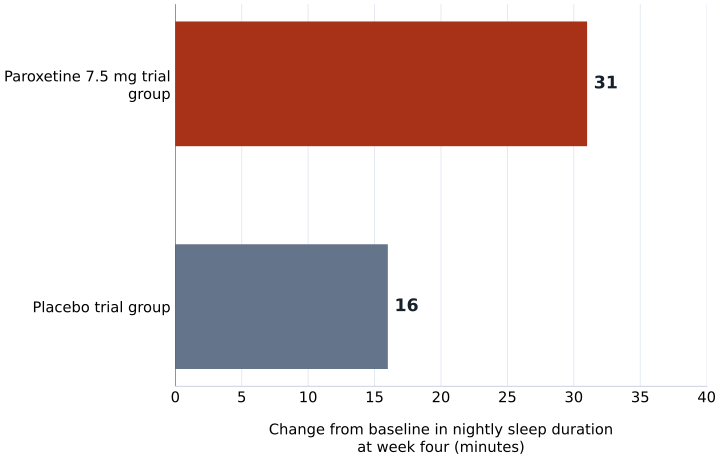
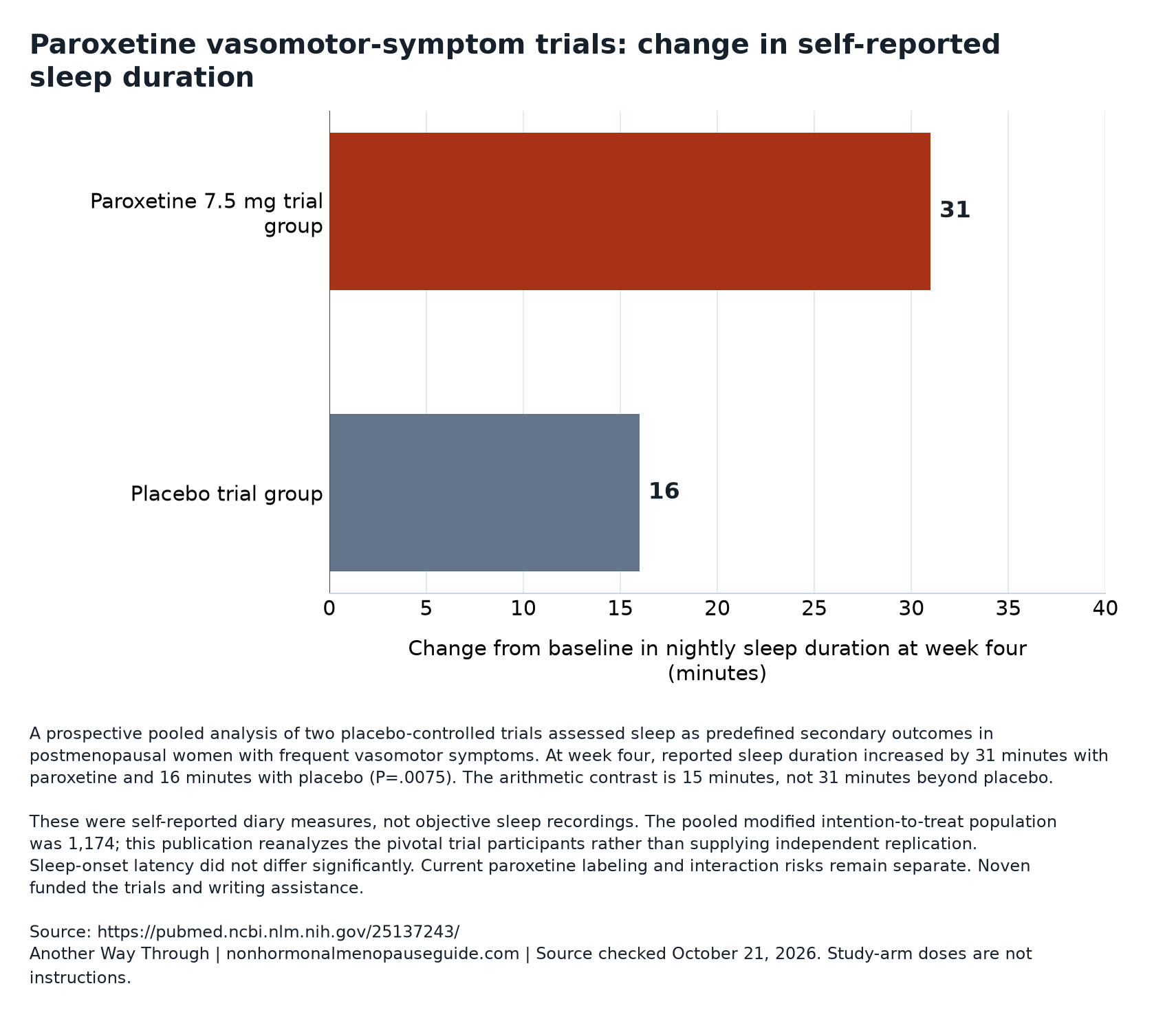
Sleep duration: Week-4 sleep duration increased 31 minutes with paroxetine and 16 minutes with placebo: an arithmetic between-group contrast of 15 minutes. Source 2
Current safety context: Brisdelle carries a boxed warning concerning suicidal thoughts and behaviors and important interaction warnings, including a potential reduction in tamoxifen effectiveness. Source 3
What the two paroxetine trials actually tested
Both studies were multicenter, randomized, double-blind, placebo-controlled phase 3 trials. Participants received an oral paroxetine mesylate capsule equivalent to 7.5 mg paroxetine or an identical placebo once daily at bedtime. These details identify the research arms, not instructions for personal use. One trial randomized 614 participants and followed treatment for 12 weeks; the other randomized 570 and followed treatment for 24 weeks.
The four primary endpoints were changes in moderate-to-severe vasomotor symptom frequency and severity at weeks 4 and 12. Vasomotor symptoms, or VMS, means hot flashes and night sweats. Counting episodes and rating their intensity are different measurements: a treatment could reduce how often symptoms occur without producing an equally clear change in how intense the remaining episodes feel.
The primary symptom report is available here through its indexed abstract; the sleep analysis is available as a full research article. Current official prescribing information adds numerical symptom results and safety context. This analysis does not assume access to every original protocol or supplement. The broader guide to nonhormonal medicine families helps keep drug categories separate from the outcomes each study measured.
Read the underlying chart data: download CSV or download the source-labeled chart.
Participants had frequent symptoms, not a required insomnia diagnosis
Participants were postmenopausal women aged at least 40, with a history of roughly seven to eight or more moderate-to-severe hot flashes daily, or 50 to 60 weekly. In the pooled sleep-analysis population, the average baseline burden was 11.3 daily vasomotor episodes and 3.6 nightly awakenings attributed to those symptoms. This was a symptom-intensive population, not a sample of everyone experiencing menopause.
The studies excluded important groups, including women with psychiatric disorder histories, known prior nonresponse of VMS to an SSRI or SNRI, and specified unstable cardiac or impaired liver or kidney conditions. Conversely, there were no sleep-specific exclusions for conditions such as sleep apnea or restless legs. Their possible presence was not the same as systematically diagnosing them or measuring treatment effects within those conditions.
Most psychotropic drugs were prohibited. A few sleep medicines were permitted, but use was minimal and was not analyzed separately. These enrollment and medication rules matter when interpreting the results: the trials were neither general insomnia trials nor studies of paroxetine treatment in people receiving psychiatric care. A visit organized around a specific outcome should distinguish repeated symptom-linked awakenings from difficulty initiating sleep.
Hot-flash frequency improved more consistently than severity
Both trials found significantly greater frequency reductions with paroxetine at weeks 4 and 12. However, only the 24-week study met all four primary endpoints. In the shorter study, week-12 severity did not differ significantly from placebo; the current label reports P = 0.17. Saying that both trials succeeded on every symptom measure would erase that distinction.
The label reports median daily frequency changes, which are not interchangeable with the sleep analysis’s mean changes. In the shorter trial at week 12, median frequency fell 5.9 episodes daily with paroxetine versus 5.0 with placebo, a 0.9-episode contrast. In the longer trial, the corresponding reductions were 5.6 versus 3.9, a 1.7-episode contrast. Large within-group improvements therefore do not represent the entire treatment-specific advantage.
Persistence at week 24 was also assessed through a responder definition: at least a 50% reduction in symptom frequency. That threshold was reached by 48% receiving paroxetine and 36% receiving placebo, a 12-percentage-point difference. This does not mean the average symptom reduction was 48%, and it does not establish persistence beyond the observed follow-up.
The sleep publication reanalyzed the same participants
Sleep measures were predefined secondary assessments collected prospectively during the pivotal trials. Participants recorded awakenings they attributed to VMS, estimated sleep duration, and reported sleep-onset latency—the time needed to fall asleep. The investigators pooled the two studies through week 12 because their designs and populations were similar. Week-24 results came only from the longer trial.
The pooled modified intention-to-treat population included 1,174 participants: 585 receiving paroxetine and 589 receiving placebo. Eligibility for that analysis required valid baseline diary data, at least one dose, and some on-treatment diary data. Its denominator therefore differs from the 1,184 randomized participants. The safety population was slightly different again, at 1,175.
Pooling increases the amount of information available for estimating an average effect. It does not turn a secondary publication into independent replication. Nor do self-reported diaries establish changes in sleep architecture, breathing events, or objectively measured sleep stages. The diaries capture experiences that matter to participants, but the interpretation must remain tied to what they actually recorded.
Translating the awakening percentages into nightly experience
At week 4, mean symptom-attributed awakenings declined from 3.56 to 2.17 nightly with paroxetine and from 3.64 to 2.63 with placebo. These corresponded to the reported 39% and 28% reductions. The 11-percentage-point separation between those reductions is not an 11% reduction in all awakenings, because awakenings unrelated to VMS were not counted.
Subtracting each arm’s baseline from its follow-up gives reductions of 1.39 and 1.01 awakenings nightly. Their arithmetic difference is 0.38 fewer awakenings per night beyond the placebo change. That is a modest group-average advantage, not a prediction that an individual will have a fractional awakening or benefit on a fixed schedule.
The advantage remained evident at later assessments. Importantly, the studies did not establish whether individual awakenings became shorter or whether other causes of waking improved. The table keeps the reported percentages alongside the actual nightly averages so that a large relative reduction is not mistaken for complete resolution.
Self-reported nightly awakenings attributed to vasomotor symptoms
| Assessment | Paroxetine 7.5 mg | Placebo |
|---|---|---|
| Week 4, pooled trials | 3.56 to 2.17; 39% reduction | 3.64 to 2.63; 28% reduction |
| Week 12, pooled trials | 3.56 to 1.65; 54% reduction | 3.64 to 2.08; 43% reduction |
| Week 24, longer trial only | 3.58 to 1.36; 62% reduction | 3.56 to 2.02; 43% reduction |
Longer sleep did not mean faster sleep onset
At week 4, reported sleep duration increased by 31 minutes with paroxetine and 16 minutes with placebo. The arithmetic contrast is 15 minutes, not 31 minutes beyond placebo. At weeks 12 and 24, increases were 35 versus 23 minutes and 37 versus 27 minutes, respectively. Those contrasts are 12 and 10 minutes; the last assessment represents only the longer study.
All three duration comparisons were statistically significant, but a P-value does not show how many participants experienced a worthwhile improvement. The available numerical text does not provide confidence intervals for these sleep contrasts, limiting assessment of their precision. The average benefit may matter to some people, but the study does not supply a validated personal threshold for meaningful improvement.
Sleep onset followed a different pattern. At week 4, estimated time to fall asleep decreased seven minutes with paroxetine versus eight with placebo; no assessment showed a statistically significant between-group difference. This makes a broad claim that the drug helps people fall asleep unsupported. It also does not prove that no individual experienced either easier sleep onset or worsening sleep.
Broader sleep ratings and sedation complicate the picture
The sleep-interference item from the Hot Flash–Related Daily Interference Scale improved significantly more with paroxetine at week 4, but not at weeks 12 or 24. A separate Greene Climacteric Scale item on difficulty sleeping showed no significant between-group differences at any assessment. Thus, fewer reported symptom-linked awakenings did not consistently translate into superior scores across broader sleep questions.
These measures have their own limitations. The investigators noted that using the single interference-scale item to evaluate sleep had not itself been validated. A dedicated insomnia instrument or objective sleep recording could answer additional questions. The present findings are strongest for the particular diary outcomes, rather than for a universal improvement in sleep quality.
During treatment, 3.1% in each arm reported at least one sleep-related treatment-emergent adverse event. Somnolence was reported in 0.5% of paroxetine-treated participants. No significant between-group sedation difference was observed. Interpretation: the pattern is compatible with symptom-linked sleep improvement rather than a general sedative effect, but it does not prove the biological pathway or rule out sedation in particular individuals.
Low-dose paroxetine still has substantial safety considerations
Current Brisdelle labeling carries a boxed warning about suicidal thoughts and behaviors. The class warning originates in short-term psychiatric trials involving pediatric and young adult patients; Brisdelle is not approved for psychiatric conditions. Information in menopausal users is limited, and the VMS trials excluded psychiatric histories. Nevertheless, the label’s pooled phase 2 and phase 3 data report three serious suicidal-ideation reactions and one suicide attempt with Brisdelle, versus none with placebo.
That broader safety pool included 635 active-treatment and 641 placebo participants, not just the pivotal phase 3 sleep population. Headache occurred in 6.3% versus 4.8%, fatigue-related reactions in 4.9% versus 2.8%, and nausea or vomiting in 4.3% versus 2.3%. Adverse-reaction discontinuation occurred in 4.7% versus 3.7%. These findings should not be replaced by a blanket description of the treatment as safe.
Paroxetine strongly inhibits CYP2D6, an enzyme involved in drug metabolism, and can reduce the active tamoxifen metabolite. Clinical outcome studies have been mixed; the label advises considering avoidance of concomitant use. Other concerns include serotonin syndrome, bleeding interactions, low sodium, sexual dysfunction, and contraindicated combinations with MAO inhibitors, thioridazine, or pimozide. Post-discontinuation symptoms are also labeled. The trial’s cessation findings are not personal stopping or tapering guidance.
SKYLIGHT 1 answers a separate nonhormonal treatment question
SKYLIGHT 1 randomized 527 women aged 40–65 with at least seven moderate-to-severe hot flashes daily to oral fezolinetant 30 mg, 45 mg, or placebo once daily. Its placebo-controlled phase lasted 12 weeks, followed by a 40-week active-treatment extension. The analysis here uses the indexed primary report abstract and current official labeling, not an assumed review of the full trial article.
For the 45-mg arm, the abstract reports placebo-adjusted frequency changes of −2.07 daily episodes at week 4 and −2.55 at week 12, with standard errors of 0.42 and 0.43. Standard errors describe estimate precision; they are not confidence intervals. The label reports rounded contrasts of −2.1, with a 95% confidence interval of −2.9 to −1.3, and −2.6, with an interval of −3.4 to −1.7.
These estimates cannot rank fezolinetant against paroxetine: there was no head-to-head comparison, and statistical summaries differ. The separate SKYLIGHT 1 analysis develops that program further. Its early safety findings also do not override today’s boxed liver-injury warning. Current labeling requires baseline and scheduled follow-up liver tests, discussed in the liver-monitoring guide.
Why these research programs should not be treated as a head-to-head comparison
| Feature | Paroxetine pivotal program | Fezolinetant SKYLIGHT 1 |
|---|---|---|
| Randomized participants | 1,184 across two trials | 527 in one trial |
| Studied oral arms | Paroxetine 7.5 mg versus placebo | Fezolinetant 30 mg or 45 mg versus placebo |
| Placebo comparison | 12 weeks in one trial; 24 in the other | 12 weeks, then 40-week active extension |
| Sleep evidence discussed here | Predefined secondary diary analysis of the same participants | Indexed abstract emphasizes VMS frequency and severity, not matching sleep-diary estimates |
Translating the evidence into a clearly defined care goal
The historical description of paroxetine as the only approved nonhormonal VMS treatment is obsolete. Current labels identify both Brisdelle and Veozah as treatments for moderate-to-severe menopause-related VMS, with different pharmacology and safety requirements. Brisdelle’s sleep findings do not create an insomnia indication, and neither trial program establishes outcomes for a particular clinic, compounded product, alternate formulation, or route.
Interpretation: the useful care question is which outcome will be tracked—daily hot-flash counts, symptom-attributed awakenings, sleep duration, or another problem—and how adverse effects and medication interactions will be reviewed. For documentary questions about visit scope and follow-up terms, readers can consult the Midi review or Evernow review. Those reviews do not establish access to a studied product or predict results.
Funding also belongs in the interpretation. Noven Pharmaceuticals funded both paroxetine studies and medical-writing assistance; two sleep-paper authors were company employees, and other relationships were disclosed. Astellas funded SKYLIGHT 1. Sponsorship does not nullify randomized evidence, but it makes endpoint transparency, complete safety reporting, and independent replication especially valuable.
Questions about the evidence
Was the sleep analysis a separate trial confirming the hot-flash results?
No. It analyzed predefined secondary sleep measures from the same two pivotal randomized trials. Pooling their first 12 weeks improved the information available for analysis, but did not add a new independently recruited population. Week-24 findings came from only the longer trial.
Does the extra 31 minutes of sleep represent the drug’s advantage?
Not by itself. That was the active arm’s week-4 increase from baseline. Placebo participants reported 16 additional minutes, making the arithmetic contrast 15 minutes. Both changes matter when distinguishing overall improvement during a trial from the additional improvement associated with treatment assignment.
Did fewer awakenings establish that paroxetine treats sleep apnea or general insomnia?
No. Participants counted awakenings they attributed to vasomotor symptoms. The trials did not establish improvements in breathing-related events, all-cause awakenings, or objectively recorded sleep stages. A lack of sleep-apnea exclusion is not evidence that sleep apnea responded to treatment.
Does the absence of a significant sedation difference mean nobody became sleepy?
No. Statistical comparisons describe groups, not universal individual responses. Somnolence occurred in some paroxetine participants, and the label includes fatigue-related adverse reactions. The findings do not support general sedation as the explanation for improved diary outcomes, but they cannot exclude it for everyone.
Do the fezolinetant numbers show it is better than paroxetine?
No direct comparison was performed. Separate trials used different populations and statistical summaries, and the sleep outcomes are not matched here. Fezolinetant also has a current boxed hepatotoxicity warning and scheduled liver-testing requirements that cannot be inferred from its early trial adverse-event totals alone.
What this evidence supports
The paroxetine program supports reduced hot-flash frequency and a modest average advantage in self-reported symptom-attributed awakenings and sleep duration. It does not establish a general insomnia effect, consistently superior broad sleep ratings, or freedom from important adverse effects. The most informative reading separates primary VMS outcomes from secondary sleep findings, subtracts placebo improvement before describing added benefit, and treats current labeling—not historical trial reassurance—as the safety reference. Fezolinetant provides a separate evidence-based nonhormonal pathway, not a comparative winner established by these studies.
Research access and limitations
The primary paroxetine VMS report and SKYLIGHT 1 were assessed through indexed abstracts, supplemented by official prescribing information; the full paroxetine sleep article was available. Sleep measures were secondary and self-reported, and several relevant populations were excluded. Confidence intervals for the numerical sleep contrasts were not available in the accessible text. Follow-up does not establish indefinite benefit or quantify rare long-term harms.
Follow the evidence
Source documents
Read each source for the product, population and purpose it describes. Commercial pages document advertised terms, not individual care outcomes.
- Low-dose paroxetine 7.5 mg for menopausal vasomotor symptoms: two randomized controlled trials.Indexed primary study abstract · Checked 2026-10-21
- Low-dose paroxetine (7.5 mg) improves sleep in women with vasomotor symptoms associated with menopause.Indexed primary study abstract and full research article · Checked 2026-10-21
- Brisdelle (paroxetine) US prescribing informationExact official DailyMed label. Revised April 2025; exact 7.5 mg capsule, not general paroxetine tablets; same-day official HTML record reviewed with original timestamp · Checked 2026-10-21
- Fezolinetant for treatment of moderate-to-severe vasomotor symptoms associated with menopause (SKYLIGHT 1): a phase 3 randomised controlled study.Indexed primary study abstract · Checked 2026-10-21
- DailyMed — VEOZAH fezolinetant tablet, Astellas Pharma USExact oral product prescribing information, revised February 2026; boxed hepatotoxicity warning, all three contraindications and testing duties remain product-specific. Not evidence of individual clinic prescribing or a personal monitoring schedule. · Checked 2026-10-21